Category Archives: Social NW

Bank Transfer versus PayPal Casino Payouts: Which Withdrawal Method Suits UK Players Best?

Bank Transfer versus PayPal Casino Payouts: Which Withdrawal Method Suits UK Players Best?

Understanding Casino Withdrawal Options in the UK

Choosing the right cashout method matters more than many players realise. After all, a generous bonus is only as good as the speed at which winnings actually reach your account. UK-licensed casinos typically offer two main routes: direct bank transfer and e-wallet services such as PayPal. Both are legitimate, both are regulated by the UK Gambling Commission, and both have loyal followings. Discover further information on 100FreeWelcome pay by phone casino.

The key differences come down to speed, fees, and convenience. PayPal withdrawals often clear within hours, while bank transfers can take one to three working days. On the other hand, bank transfers suit players who prefer not to hold a separate e-wallet balance. Understanding these trade-offs helps you pick the method that fits your habits.

It is also worth noting that withdrawal rules are tied to deposit methods under anti-money-laundering requirements. Most UK casinos insist you withdraw via the same route you used to deposit, so your choice at sign-up shapes your cashout experience later.

With the right preparation, either method works smoothly. The sections below break down the practical details so you can decide with confidence.

Speed, Fees and Practical Comparisons

PayPal is widely regarded as the fastest mainstream option. Once a casino approves a withdrawal, funds usually land in your PayPal balance within a few hours, and same-day processing is common at reputable sites. Bank transfers are slower by design: faster payments can complete within hours in some cases, but standard processing often takes one to three working days after internal checks.

Fees are generally minimal on both sides. Licensed UK casinos rarely charge for PayPal payouts or bank transfers, though your bank may apply charges for certain account types. PayPal transfers between your balance and your bank account are typically free in GBP.

Here is a quick comparison:

FeaturePayPalBank Transfer
Typical speed2-24 hours1-3 working days
Fees at UK casinosUsually freeUsually free
Minimum withdrawalOften £10Often £10-£20
Extra account neededYesNo

Verification is the biggest hidden factor. Casinos must confirm identity before releasing funds, and incomplete documents can delay even the quickest PayPal payout by several days. Submitting ID early avoids this entirely.

Why the Best UK Casinos Make Both Methods Effortless

The quality of the cashout experience depends heavily on the operator. A premium UK site will process PayPal withdrawals within hours, keep bank transfers within a single working day where possible, and offer transparent status updates throughout. Look for clear published timeframes rather than vague promises.

Generous bonus structures also matter. Leading UK platforms pair fast payouts with offers such as 100 free spins, £10 no deposit bonuses, and deposit matches of 100% to 400%, giving players genuine value before they ever reach the withdrawal stage.

Before cashing out, check wagering requirements, maximum withdrawal caps, and any payment method restrictions attached to your bonus. These conditions catch out more players than processing times ever do.

In short, PayPal wins on speed, while bank transfers win on simplicity. Whichever you choose, prioritise a UK-licensed casino with verified fast processing and fair terms, and your winnings will reach you without unnecessary friction.

How to Choose Slot Games by Payout: A Practical UK Guide

How to Choose Slot Games by Payout: A Practical UK Guide

Understanding RTP and Why It Matters

Return to Player, or RTP, is the single most useful figure when comparing slot games. It expresses, as a percentage, how much of all staked money a slot is designed to return to players over millions of spins. A game with 96% RTP theoretically returns £96 for every £100 wagered, with the remainder forming the house edge. Read more about this at view all offers.

In the UK market, most online slots sit between 94% and 97%. Small differences compound quickly. A 97% game carries a 3% house edge, while a 94% game carries 6% , meaning you lose twice as much on average per spin. Over a session of 500 spins at £1 each, that gap represents roughly £15 in expected value.

Be aware that RTP is a long-term average, not a promise for any individual session. Variance means short sessions can swing wildly in either direction, but choosing higher-RTP games tilts the maths in your favour over time.

Regulated UK operators must publish RTP figures, usually within the game information screen or paytable. If a slot hides its RTP, treat that as a warning sign and move on.

Reading Paytables, Volatility and Hit Frequency

The paytable tells you what each symbol pays and how many you need to land. Pay particular attention to the gap between the top symbol and the rest , an enormous jackpot symbol often signals low hit frequency elsewhere.

Volatility describes how a slot distributes its wins. Low-volatility games pay smaller amounts frequently, medium volatility balances both, and high-volatility slots pay rarely but potentially large. Your choice should reflect your bankroll and patience rather than pure ambition.

Hit frequency, sometimes listed as win frequency, shows the percentage of spins that produce any return. A slot with a 25% hit frequency wins on roughly one in four spins. Combine this with RTP and volatility to build a full picture.

Also check maximum win caps. Some slots advertise 10,000x your stake, while others cap at 500x. A high RTP paired with a low cap may suit steadier play, while thrill-seekers often accept lower RTP for a shot at a bigger ceiling.

Bonus mechanics matter too. Free spins features with high multipliers can lift the effective RTP, and some games let you buy features directly , usually at a cost that reflects the added value.

Where UK Players Find the Best Value

Rather than hunting across dozens of sites, look for a platform that curates the highest-paying slots alongside transparent bonus terms. No Deposit UK is a strong example: it lists titles with published RTPs, offers a £100 free welcome bonus with no deposit required, and includes free spin bundles such as 100 free spins, 500 free spins and 1000 free spins packages.

Its range covers free £5, £10, £20 and £30 no deposit offers, plus deposit matches from 100% to 400% and slot bundles like £5 for 100 spins with no wagering. Combined with a catalogue spanning Big Bass and Book of Dead spins and daily free spins on high-RTP slots, it gives UK players an easy route to compare payout rates before committing a penny.

Practical Checks Before You Spin

Start with a simple rule: refuse anything below 95% RTP unless a specific feature justifies it. Then verify the figure inside the game itself, since demo versions sometimes differ from real-money versions.

Next, match volatility to your budget. Set a session limit in GBP and choose low or medium volatility if you want that money to last. Finally, review the wagering attached to any bonus , a generous-looking offer with 65x wagering rarely beats a modest bonus with 10x.

Take notes on which slots deliver value for your style of play. A handful of well-chosen games consistently outperforms a scattergun approach.

Understanding Casino RTP and Volatility: A UK Player’s Guide

Understanding Casino RTP and Volatility: A UK Player’s Guide

Return to Player percentage and volatility are the two figures that shape every session on a UK-licensed slot or table game. RTP tells you what proportion of stakes a game returns to players over millions of spins, while volatility describes how those returns are delivered , in a steady trickle or a handful of dramatic bursts. Get to grips with both and you can match games to your budget and temperament instead of guessing. Check out additional details at 100FreeWelcome best gambling sites.

UK Gambling Commission rules require licensed operators to publish RTP where relevant, and the figures usually sit between 92% and 97%. That sounds generous until you remember it is a long-run average, not a promise for your next twenty spins. A 96% RTP slot keeps an average of £4 from every £100 staked over its lifetime , but any individual session can swing wildly either way.

What RTP Really Means for Your Bankroll

Think of RTP as a measure of house edge, expressed in reverse. A game with 96% RTP carries a 4% theoretical edge; one at 94% carries 6%. Over thousands of spins, that two-point gap compounds enormously. Staking £500 on a 96% slot implies average losses of around £20, while the same £500 on a 94% game implies closer to £30.

Where you really notice the difference is in game choice. Jackpot titles often dip to 92-94% because a slice of every stake funds the prize pool. Highly optimised slots from major studios frequently publish 96%+ on their default settings, so it is always worth checking the paytable or help screen before you deposit. Some operators offer multiple RTP configurations of the same game, and UK-licensed sites are expected to display the version you are actually playing.

Short sessions rarely reflect RTP at all. Spin 100 times at £1 and your result might be +£40 or −£60 regardless of whether the game pays 95% or 97%. The statistic becomes meaningful across tens of thousands of spins, which is precisely why it should inform your game selection rather than your expectations for a single evening.

Volatility: How Variance Shapes the Ride

Volatility , often labelled low, medium or high , describes the frequency and size of payouts. Low-volatility slots land wins often but small, making them comfortable for longer sessions on modest stakes. High-volatility games can go dozens of spins without a return, then deliver a multiplier worth hundreds of times your stake.

The numbers behind variance are stark. A high-volatility slot might hit a win on roughly 20-25% of spins, with the bulk of its RTP concentrated in rare bonus rounds. Medium games typically land wins closer to 30% of spins, while low-volatility titles can pay on 40% or more. None of this changes the RTP , it simply redistributes when the money arrives.

Bingo and roulette sit at the gentler end, with frequent small returns. Progressive jackpot slots anchor the extreme. Matching volatility to your stake size matters: a £10 budget spread across 10p spins on a high-variance game gives you 100 chances at a big hit, whereas the same budget on a low-variance slot stretches far longer with steadier feedback.

Practical Tips for Choosing Games in the UK

  • Check the published RTP before playing , anything at 96% or above is competitive for UK slots.
  • Read volatility labels in the game info panel; most UK operators now display them clearly.
  • Pair high volatility with smaller stakes and larger budgets to survive dry spells.
  • Treat bonus funds carefully: wagering requirements can mean the effective RTP of a bonus playthrough is lower than the base game’s.
  • Use demo modes where offered to sample variance before committing real funds.

Neither RTP nor volatility can predict a single spin, and no strategy changes the underlying maths. What they do offer is informed choice , a way to align the games you play with the budget and excitement level you actually want. Treat both figures as tools for planning, keep stakes sensible, and the house edge stays a cost of entertainment rather than a nasty surprise.

Facebook Messaging App

Facebook debuted a new app for smartphones Tuesday, allowing users to send text messages to each other from their smartphones using Facebook’s messaging system.

The app in question — Facebook Messenger — is an extension of Facebook’s existing messaging system, which allows two Facebook users to communicate within the Facebook platform. As a standalone program separate from the Facebook app, Messenger allows Facebook users to send text messages between phones, while still storing the conversation in a user’s messaging center on his or her individual Facebook page.

Facebook’s Messenger app is also capable of group texting, letting you pick multiple Facebook contacts and send them all texts at once. If a FB user is logged into the new message app, it’ll show up there. If not, they get the message sent to them as an SMS, so long as they’ve registered their phone with Facebook. The service is mobile-focused, so it doesn’t completely integrate with Facebook Messages, which tries to route a message to a person using whatever channel Facebook thinks is most likely for you to get it fastest.

Facebook allows unborn child to be listed as family

Facebook is now letting parents-to-be list their unborn children on their personal profiles.

Among options that include daughter, son, wife and husband, the “Friends and Family” section under “Edit Profile” now allows the option “Expected: Child.” Parents can add a due date and the baby’s name.

With the feature, the expected child would appear next to other family members on the user’s profile and the changed status would appear in friends’ News Feed.

Read More @ CNN

Facebook privacy controls

Facebook allows you to share almost anything and everything with your friends. But what if some day you get a friend request from your Boss, you cant say Ignore and you also don’t want to accept. Here comes the role of Facebook privacy controls. You can customize them such that you can have things hidden from who ever you want on an individual or group basis.

Controls can be set for individuals but it is better if all the Facebook friends are grouped into various lists as Facebook prefers to call them.

Following is a step by step walkthrough to do it.

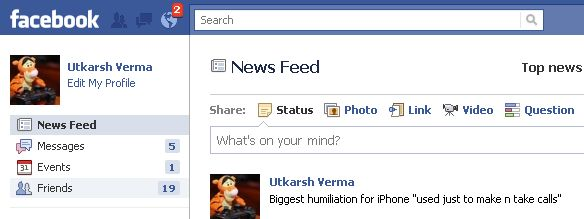
Login to Facebook.

image

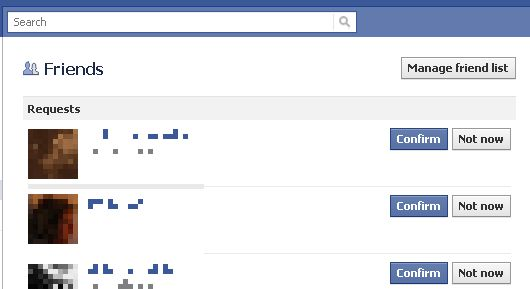
Click the Friends tab on the left column as shown above. This would take you to the all friends list.

image

Click manage Friends List on the top right corner. This would lead to all the lists that you have made of friends, colleagues etc. as shown below.

image

If needed you can also create a new list by clicking the button create list which is on top right (cropped out in the above depiction)

Once you have your lists in place head over to account management.

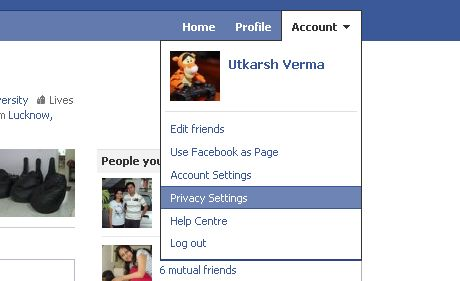
image

Go to Account >> Privacy Settings.

This would take you to a page which shows the summary of current privacy controls in place.

Here you can configure what you want to show to who. Following will be just an example and you can customize everything in the same manner as shown.

image

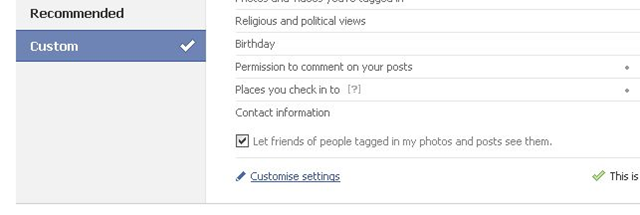
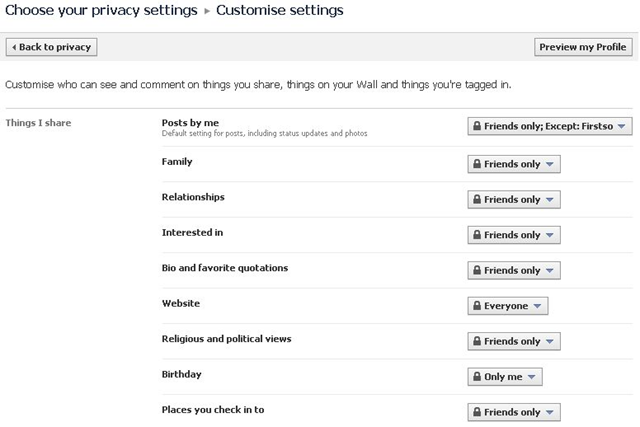
Click Customize to go to the individual controls page.

image

Here you can Customize privacy controls for Things shared by you and others and contact related details. The following examples shows it only for posts. Rest can be done in same way.

image

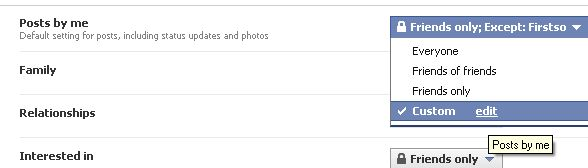
Click on the tab to open the drop down and click edit to customize. This brings up the following popup.

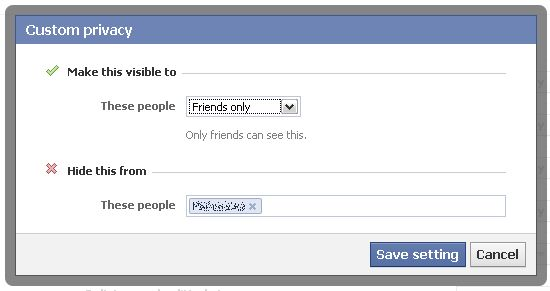
image

Here you can select the setting from the drop down for who to show and to hide the updates just type in the friends name or the list name in the below “Hide this from” section.

Save settings and you are done.

This same can be done of all kind of updates.

Do let us know if this was of any help to you. 🙂

Facebook for Business – enhancing business with social media

Facebook on Tuesday debuted a step-by-step online guide aimed at helping small businesses use the social networking site. The company is billing the new webpage, found at Facebook.com/business, as an “online education center” that gives directions on such things as how to set up a profile page, create targeted ads and deals, and interact with customer feedback online.

The timing is interesting, as it comes just a week after Google began shutting off all company profiles on its Google+ social network. The search engine giant says it’s just company policy to restrict Google+ access to individual users, a stance that has inspired a good deal of controversy in recent days.

Facebook’s new business webpage does not come along with any new features — it simply puts a lot of information that may be handy for small businesses in one place. Perhaps most importantly, it serves as a nicely timed reminder that unlike Google+, Facebook encourages companies to use its service for company branding.


Zynga $ 1 Billion IPO

http://www.watblog.com/wp-content/uploads/2011/03/Zynga-Logo.jpg

Zynga, the online game developer that made Facebook a safe haven for desk-bound farmers and wannabe Mafia hit men, has decided to cash in on all the fun with an initial public offering filing Friday that expects to raise $1 billion.

Zynga’s S-1 SEC filing begins with a chatty, casual appeal from founder and CEO Mark Pincus: “At Zynga, we feel a personal connection to our games through our friends and family. I love that my brother-in-law, who has five kids and no free time, religiously plays our game Words with Friends.”

But the filing also confirms that it is not all fun and games at the 4-year-old company, which has 2,000 employees and boasts 60 million daily active users. There’s a big differentiator from some other red-hot tech IPOs that have exploded in value on their first day of trading in 2011.

They make money. About $90 million on revenues of nearly $600 million last year.

Zynga hopes to raise as much as $2 billion in a public debut that could value it at as much as $20 billion, “people close to the deal” told the Wall Street Journal. This probably will not be a game of chance for Zynga, what the prevailing “What dot-com bust?” attitude on Wall Street for internet, tech and similar IPOs.

Facebook’s awsome launch next week

http://s3.reutersmedia.net/resources/r/?m=02&d=20110630&t=2&i=449747175&w=460&fh=&fw=&ll=&pl=&r=2011-06-30T174135Z_01_BTRE75T1D5Q00_RTROPTP_0_FACEBOOK

Chief Executive and founder Mark Zuckerberg told reporters in a visit to Facebook’s Seattle office on Wednesday that the company planned to “launch something awesome” next week.

He said the project had been developed at the 40-person Seattle office, Facebook’s only major engineering center outside of its Palo Alto, California headquarters.

There has been speculation in technology blogs in recent weeks about various mobile products in development at Facebook, including the release of a long-awaited Facebook app for Apple Inc’s iPad and a specialized app for photo-sharing on the iPhone.

Facebook’s Seattle office has made a mark on the company’s mobile efforts, playing a central role in the development of Facebook’s unified mobile site, unveiled in March.

Facebook Credits in India next month onwards

Social networking giant, Facebook has made an announcement that it would be rolling out its latest service, Facebook Credits. The bigger news here would be that the service has been launched in 11 countries, including India.

Now, in India

Starting from July 1, 2011, Facebook Credits intends to be used as an alternative payment option on the social networking giant. The payment option would be supported by Live Gamer. Facebook credits would allow users to buy virtual currency and virtual goods that are being made available to them in their Facebook apps. The only hiccup, possibly here is that the credit service doesn’t allow payment in Indian Rupees, at least for now. Therefore, users would have to purchase 50 credits for $5.