Category Archives: General

Real Estate Investments Made Simple

http://www.muamat.com/adpics/4de0cbb7557c4fddc14c05988.jpgGold and Real estate are very traditional investment avenues. Gold has evolved from its traditional investing and found its place in the modern sophisticated investment world via Gold ETFs. Similarly Real estate is also emerging as an investor friendly avenue with less hassle via PMS route or private equity route. Have you ever thought of investing in real estate will one day be as simple as investing in mutual funds? If no please read on….

Real Estate as an Investment:

Buying a dream house or flat to reside ourselves is basically not a real estate investment. Buying real estate with a view to generate income and capital appreciation is considered as Real Estate investments.  Real Estate investments can be further classified into residential, farm house, commercial, retail, leisure. Leisure is a relaxation place where one can spend their free time or vacation.

Depends upon his/her risk tolerance and time horizon one can invest in real estate at different risk levels. It can be at the time of converting a rural land to urban land, or at the time of building development stage or in already developed city area.

Real Estate and Risk:

Most often investors assume real estate prices will not fall down and they only go up year after year. It is not so.  During the mid 2009 some of the real estate investments were quoting below 30% to 40% from their 2007 prices. Real Estate investments are also prone for price fluctuations.

Real estate Vs Stock market:

Real Estate is a complex and complicated investment when compared to stock market.

Non-transparent: There is no transparency in the price. It is not easy for a buyer or seller of real estate to identify the last transacted price in the same locality. There is no price discovery mechanism.

Illiquid Asset: Selling a real estate is a time consuming process. It is not liquidable easily. There is no organized market for the buyers and sellers to meet.

Impact Cost: Stamp duty and registration charges are really very heavy when compared to the other investment products.

No Regulator: There is no regulator for the real estate participants and intermediaries. Anyone can become a builder. Technical qualification is not mandatory. Also anyone can become a real estate intermediary or advisor. There is no certification or training to be completed before practicing.  As there is no qualification requirement for participants as well as the intermediaries, it is very difficult to see best business practices.


Real Estate hassles:

The other hassles with reference to real estate investment are documentation, maintaining the asset without any encumbrances, and genuineness of the title deed.

There are some practical problems with diversification. Normally an investor invests in a real estate in his own locality. It is very rare to find someone in Chennai investing in the real estate properties located at Mumbai, Delhi or Kolkata.  Affordability also limits diversification. An investor may not be able to diversify his investments across various cities with Rs.25 lacs or 50 lacs.

It may not be possible for an individual investor to buy a land and develop a viable project in that land and sell it in the market. Managing the project development need some kind of expertise.  Even if an individual is able to do it, he will be doing it in his limited ways and means.

Is there a solution for this? Of late yes.

There are some collective investment vehicles. These investment vehicles will be promoted by an investment management company. The investment management companies collect money from investors. Being professionals, they will identify good projects and do joint venture with the project developers. They will be able to diversify across various cities as well as various types of real estate investments such as housing, commercial, hospitality and the like. These investment management companies charge a reasonable management fees.

At times they collect money via PMS route and at times via private equity route.  The minimum investment ranges from 10 lacs to 25 lacs. This amount needs to be invested over a period of 3 years. That is they will collect money from investors in 4 or 5 installments. After 3rd year whenever they exit from a project they will repay the principal employed in the project as well as the profit generated out of that project. End of 6th year or 7th year, the investment management company will exit from all the projects.

The advantages of this collective investment vehicle are

  • One can invest into real estate without any hassles. All the hassles will be managed by the professional investment management companies.
  • One can invest in various real estate projects at a time.
  • One can geographically diversify his investments across India.
  • One will be able to apportion his total investment into small sums in large projects like township development, Technology Park, industrial estate, health city…
  • Cost advantage because of economies of large scale operation

This is really an investor friendly investment vehicle. Apart from the regular stocks, mutual funds and fixed deposit investments investors can consider investing in these real estate products also. This will give better diversification to your overall portfolio. Also Investors need to be careful in choosing such investment options. Background of the investment management company and their transparency levels are more important. Investors can seek the advice of the professional financial planners before investing.

This investment vehicle is in its primitive form only. It still needs to go a long way. As of now there are only a very few companies in India which specializes in promoting collective real estate investment products. But in a few years time these kinds of products will be available from various investment management companies and in different varieties like our present mutual fund schemes.

The author is Ramalingam K, an MBA (Finance) and Certified Financial Planner. He is the Founder and Director of Holistic Investment Planners (www.holisticinvestment.in) a firm that offers Financial Planning and Wealth Management. He can be reached at ramalingam@holisticinvestment.in.

Instruction Manual for Investing

http://www.onlinefinancialupdate.com/wp-content/uploads/2009/01/investment.jpgLet’s open the manual:

Every gadget you buy in the market comes with an instruction manual or user’s manual. But your salary, savings…retirement don’t come with an instruction manual.  So we don’t know how to handle these and we end up mishandling. The result is poor investment choices and unhappy retirement. This article is an effort to draft an instruction manual for our investments.

Investment forms an integral part of our work life, with many wanting to save and invest to meet our long-term financial needs. We would all agree that just living from paycheque to paycheque would leave us in a bad financial state making us incapable of meeting our family’s financial commitments and our expenses after retirement.

Don’t Fly Blind; Have a Financial Plan

It is vital to chalk out a financial plan at the very beginning of our career. This plan would tell us how much we should save and invest. This plan also ensures that our long-term financial needs are met. It may prove difficult and sometimes costly in the long run if we chalk out a financial plan on our own. So it is better to engage a professional financial planner, who would be in the right position to advice us on the investments to meet our long-term objectives in life.

Generally investment advisors or financial planners ensure that we invest in the right type of investments that are relatively safe and tax efficient. They ensure that our investments do not divert away from the set financial goal. The advisors or planners who charge a fee, can be expected to act in the best interest of us; their clients. But we will not be in a position to trust those who live out of the commissions earned from selling insurance policies or mutual funds or stock broking.

However, it is best for you also to be cautious and not allowed to be fooled by flattery. Since it is your money you need to be cautious and vigilant.

Do control what you can:

The first thing that we can control is unnecessary expense on investment.

It is in our interest to try to minimize or avoid investment expenses like entry load, exit load, fund management fees, commissions for buying and selling stocks, account maintenance fees,  allocation charges, administration charges, surrender charges, and other overheads. Small drops make a mighty ocean. Similarly these small amounts of cost cutting will definitely pay us in the long run.

The second control is over the diversification of your investment. You also need to ensure that at all times your investments are done over a wider variety of assets. This will ensure that you do not suffer large losses in one type of investment. The losses in one would then be offset by the gains in the other and you will be financially safe at all times.

The third control is the maintenance of our asset allocation to reach our financial goal. We need to keep a check over the asset allocation or ratio of equity to debt and to other things in your portfolio with the help of a professional financial planner. This will help us ensure that we are not taking more risk than what we want or can possibly handle.

Do pay as little attention as possible to the financial media.

It is best not to be influenced too much by the media to buy and sell investments. Investing is not a competitive sport. Buying and selling stock frantically by being influenced by the media is counter productive to your financial objectives.

It is best to understand that our conscious investment is for long-term wealth appreciation. So we should not be distracted by the investment shows that run 24 hrs a day, investment column they publish 365 days a year. Media doesn’t understand your requirements. So it is difficult to get a customized solution for your personal finance.

Don’t fall into “Invest and Ignore”

We have invested your precious savings, so do not be careless and sleep over it. Though our investment advisor would make sure that our investment grows, it is better that we too are vigilant and keep track of market conditions. It is our precious savings that we have invested. So if we lose it, we would be losing not only money but also our peace of mind.

Don’t fall into “HNI Trap”

Being a high net worth person exposes us to being influenced to invest in dubious projects that may bring down your financial status. This is true because the financial industry are on the look out for people that have a lot of money and are of a high status. They try to influence them to invest in dubious projects appealing to their status and vanity.

Being a HNI doesn’t mean that you need a completely different set of investments. They try to pack something and will say “This is a HNI product”, just to massage your ego and get business. Many HNIs would be lot richer, if they could have bypassed their private banking department and just invested in an index and a very few diversified equity funds.

A final thought:

The instructions in the user’s manual need to be used to get the maximum benefit and long life of the gadget. Similarly, having read the set of instructions to make wise investment decisions, it is up to you to follow them strictly or leave it and go back to your routine life.

If you decide to follow these instructions, you will definitely see a lot of positive changes and financial prosperity in the long run. So today is going to be the first day for rest of your life.

The author is Ramalingam K, an MBA (Finance) and Certified Financial Planner. He is the Founder and Director of Holistic Investment Planners (www.holisticinvestment.in) a firm that offers Financial Planning and Wealth Management. He can be reached at ramalingam@holisticinvestment.in.

Do’s and Don’ts in the Stock Market

http://www.tech2date.com/wp-content/uploads/2011/04/Stock-Market-Startup-Tips.jpg

Let’s introduce do’s and don’ts of investing:

Most of us have our own perception of investment based on our experiences, but also tend to be confused with the opinions given by others. Knowing the do’s and don’ts of the stock market would help us turn really as a smart investor.

The do’s and don’ts in the stock market are:

slow, steady, and boring wins the race:

It is best not to panic over information about stocks on the media. Being slow and steady with looking at the activities that your money is to be used for would ensure that you invest in ventures that are good, useful and profitable.

Reading good books on personal finance will help you in taking right financial and investment decision. In addition, finding good financial advisors would help you get advice regarding stocks and mutual funds, along with entrusting the custody and management of your funds to them.

All this may seem too boring and time consuming, but it is better to be cautious than bitten too hard.

Don’t give any weight to market forecasts. All opinion pro and con is already built into the price of equities today:

Market forecasts on the media has got good entertainment value but doesn’t have any investment value. It is just enough for long-term investors to invest in good stocks, and mutual funds that would appreciate in the long run.

It is best to understand that market forecasts only show you the expected direction in which the market is heading based on the available information. This forecast is only a forecast and need not become reality.

In addition, market fluctuations are the very nature of share markets and should mean nothing to long tem investors. Making accurate market forecasts is tough, as they are influenced by various factors like the outcome of political elections, the direction of the economy, interest rates and world events. It is also wise to know that these fluctuations are incorporated in the price of the share, stock or mutual fund.

Do make your own analysis of the stocks, shares and mutual funds:

It is unadvisable to place your full faith on analysis of others regarding stock, shares and mutual funds. No wise man would always tell you all about his market beating strategy. Making ones own analysis keeping your financial goals in view and framing a strategy would help.

This involves studying the performance of top performing stocks and mutual funds over 5 years and existing mutual funds over a period of 3 months to decide on which stock to maintain and which to dispose off. All this would ensure that you are investment smart.

Don’t think you can successfully engage in short-term market timing:

As a long- term investor you should never contemplate taking advantage of short-term market dealings and speculations. Playing with shares and mutual funds in the short-term market may give you a profit in a few transactions but will not give you profits forever. So you can’t have an investment strategy which gives profit inconsistently. We need a strategy which can bring profits consistently so as to be a successful investor in the long run.

It is true that playing in the share market is neither entertainment nor fun. It is also futile to borrow or work on short-term margins to make money.

Don’t assume that if anyone were genius enough to devise a market-beating strategy he would be stupid enough to share it with anyone:

Stock tips are good to learn, but not to act on for speculations. It could prove dangerous to act on speculation tips given by one and all, as they may not be correct.  In addition, everyone has his or her own perception of investment, with other not having full knowledge or skills.

You need to take time to think over each tip and analyze if it contributes to your long-term objective of capital appreciation. Similarly it is not advisable to subject your money to risk with investing in investment fads that may or may not earn you huge profits.

The final advice:

You need to make a calculated decision considering the pros and cons whenever you make an investment. In addition abstain from trading often in the stock and mutual funds market. Always think in terms of long term investing.

The author is Ramalingam K, an MBA (Finance) and Certified Financial Planner. He is the Founder and Director of Holistic Investment Planners (www.holisticinvestment.in) a firm that offers Financial Planning and Wealth Management. He can be reached at ramalingam@holisticinvestment.in.

Sri lanka Auto Drivers Against TATA Nano

http://www.bsmotoring.com/story_img/bigimage/1308727846A3699.jpg

Taxi drivers in Sri Lanka’s capital held up traffic today, demanding the government should stop allowing anymore use Tata Nanos on the streets that offer stiff competition to the ubiquitous three-wheelers.
Hundreds of three-wheel taxis choked parts of the city for over an hour to protest against a taxi company, linked to a ruling party politician, from using a fleet of Nanos.

The politician was seen at the wheel of a Nano with President Mahinda Rajapaksa at the passenger seat this week after Nano Cab company launched the cheaper taxi service earlier this month.

The Federation of Self-Employees (FOSE) said their members would lose business if the Nano cabs were allowed to expand.

The cab company had said it wants to increase the current fleet of 45 to 200 by the end of the year.

FOSE said President Rajapaksa had promised in his election manifesto to grant them tax concessions to help reduce environment pollution caused by the Indian-made three wheelers, which have become the common man’s taxi.

The Nano service is offered at a lower price than air-conditioned cars and their fares are comparable to three-wheeler charges.

“we are going to lose our jobs and the Nano cabs will take over our taxi stands,” a spokesman for the protesters said.

Nano, although considered the world’s cheapest car, in Sri Lanka costs about Rs 3,81,204 (INR) and Rs 9,31,345 in Lankan Rupee ($8,500), nearly three times more than its cost in India.

Lokpal bill differences

http://static.ibnlive.com/pix/sitepix/06_2011/anna_govt_gfx_271x181.jpgThe civil society representatives and the Government were able to settle some disputes on Monday, but new differences have emerged ahead of the final Lokpal Bill Drafting Committee meeting on Tuesday.
Prime Minister Manmohan Singh has called for a meeting of the United Progressive Alliance (UPA), ahead of the all-party meet on the Lokpal issue. The Union ministers on the Lokpal Bill drafting committee will be meeting Union Finance Minister Pranab Mukherjee.

The Government has clarified that only one Lokpal Draft Bill will be sent on to the Cabinet, and both sides have admitted that crucial differences still remain and a consensus is unlikely ahead of Tuesday’s final Lokpal meet.

Read more at IBNLive

Village names itself Snapdeal.com

A village in northern India voted to change its name to Snapdeal.com Nagar, after an Indian startup installed water pumps in the town, showing how the power of philanthropy can work in strange ways.
The town, formerly named after the Hindu god Shiva, reportedly decided on the name change after Snapdeal, a leading Indian e-commerce company, installed fifteen hand-powered water pumps so that villagers would no longer have to walk nearly two miles to access clean water.

“It cost us $5,000 max, but it was quite life changing for residents there,” said Kunal Bahl, founder of the company, to CNN.

The villagers’ decision to rename the town was apparently spontaneous. “They just wanted to express their gratitude,” said Bahl.

Bahl said he hoped Snapdeal’s action would both highlight how the government is failing the rural poor and also inspire other Indian companies to take on philanthropic projects.

“India has about 640,000 incorporated companies,” he said. “Many are much larger and more resourced than us. Even if ten percent decided to do something like this, 64,000 villages would have clean water.”

Bahl said he intends to continue his company’s relationship with the town, with a plan to donate computers next on the agenda.

Entertainment setup with PS3, Laptop and External HDD


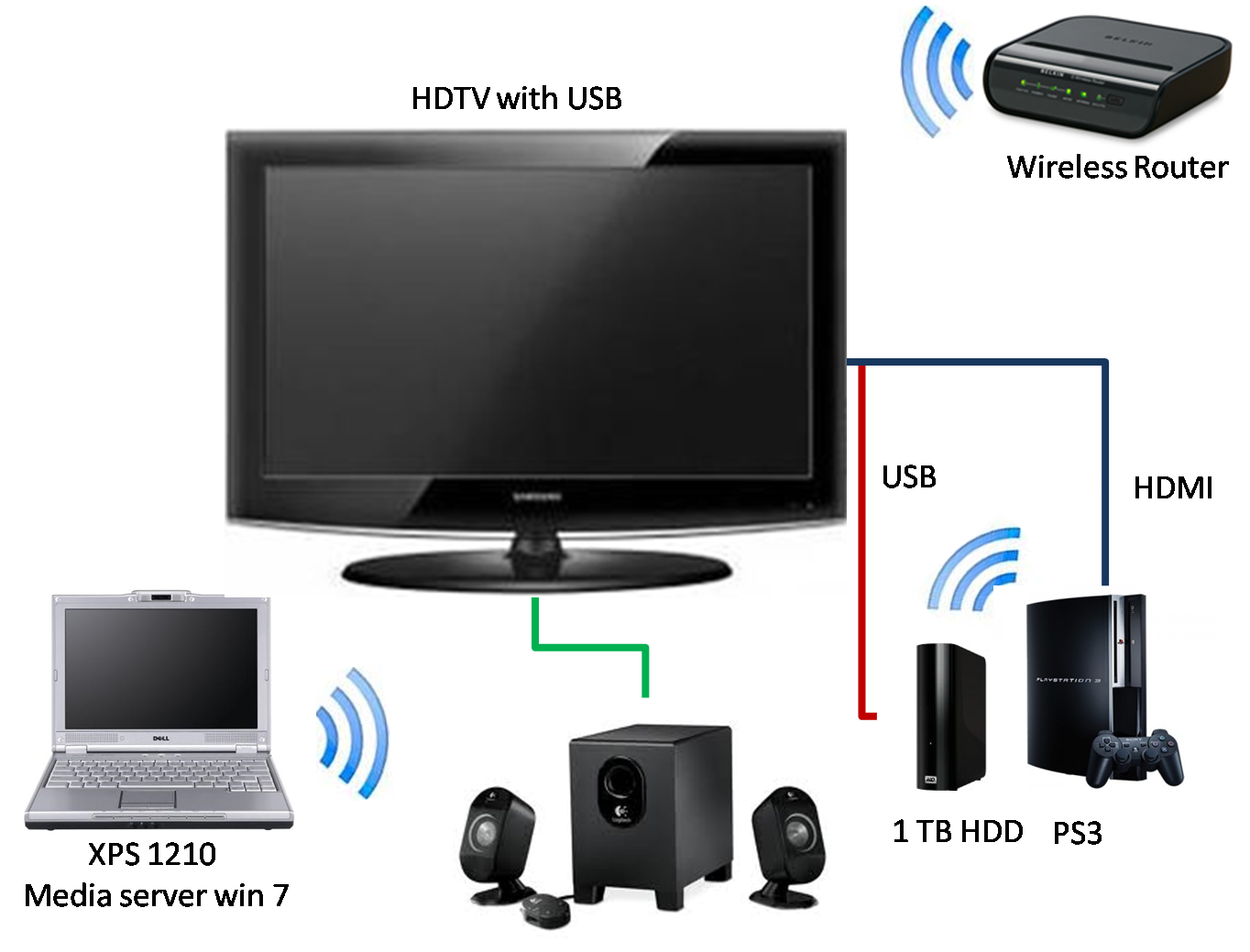
My current setup with a PS3 connected to HDTV along with a one TB WD MyBook 1110 full with movies photos and TV serials connected to TV via USB and my XPS 1210 running windows 7 media server. The laptop and PS3 are connected through a wireless network and PS3 is connected to TV via HDMI.

This is my latest media setup which allows me to play games as well as movies, music and photos stored on my laptop without copying to PS3.

The wireless network is secure (WEP + MAC restricted). I choose which devices can connect to my wifi network.

My XPS runs a media server which my PS3 can easily detect over the wifi network. It can play almost all the music, photos and movies that are stored on the laptop. All I had to do was configure the laptop as a media server

My TV is Samsung series 4 (nothing too fancy) HDTV and can run the content on the 1 TB HDD via USB. This doesn’t need the PS3 to be switched on.

The audio out of TV is connected to my 2.1 channel speaker system. 2.1 is decent enough as I have a rented home and I just didn’t want to go through the hassles of setting up a 5.1

I consider this an ideal setup for me for the following reasons

1.       I hate to keep copying content from one device to another.

2.       It keeps it hassle free.

3.       As all my devices are mostly on I don’t have any issue.

4.       I can play, watch movies and listen to music from the comfort of my bed.

5.       The speakers are awesome. I can control the volume via the TV.

Mercury rising in Punjab and Haryana

http://www.staffsoc3.org.uk/UserFiles/Image/rising_temperature.jpgWith climate change a real concern, the Indian Meteorological Department (IMD) has found that, since 1980, temperatures have been increasing in Punjab and Haryana while there is a decrease in rainfall in both states. The findings are based on the analysis of quantified data,collected over a 30 year period, from 1980 to 2010.

The data shows that in Punjab, there is a rise of 0.3 degrees Celsius to 0.9 degrees Celsius in maximum temperature and a 0.3 degrees Celsius to 1.2 degrees Celsius increase in minimum temperature over the last 30 years. In Haryana, there is a rise of 0.3 to 0.6 degrees Celsius in maximum temperature with no significant change in the minimum during the same period.

Nokia ovi to be rebranded as Nokia

http://www.fonearena.com/blog/wp-content/uploads/2009/03/nokia-ovi-logo-app1.png

Nokia today announced that it will phase out its Ovi brand and rebrand it as Nokia from July.

“The target for rebranding is 18 months, but we hope to do it earlier. It will be seamless switchover to the new brand and there will be no impact on customers,” Nokia marketing director Viral Oza said here on the sidelines of the launch of a dual sim phone.

The new devices to be launched will have the new branding of Nokia and for older handsets new applications will be upgraded gradually, he said.

The company expected to do well in the dual-sim phone market that contributed 40 per cent of the total Indian handset market.

Use PS3 to play content stored on Computer

Before we proceed I would request you to note down the MAC address of your PS3

You can find your PS3 MAC address in

1) System Setting > System Information

2) Network Settings. (Scroll towards bottom)

Once you note down the Mac address then on your PC go to Control Panel > Network and Sharing Center > Change Advance Sharing Settings.

Then you need to make sure:

– Network Discovery is ON
– File & Printer Sharing is ON

After that click on Media Streaming options.

Once you are done with it you would see a window of Media Sharing

On the Show devices drop bar, select All Networks

Then you would see some Unknown device / devices.

I Recently bought a PS3. Now yoy can not copy all your videos, music and photos to the 320 GB HDD. But you can use your windows 7 to act as media server for PS3 and play all your content on PS3

Here is how to go about it.

Double click each Unknown device to see the MAC address of the device. If the address matches your PS3 MAC address then allow that device for media sharing.

You would now be able to share your media (If your firewall is not blocking media access)


With the latest updates in Windows 7,  you also need to make sure the following setting

Open “Services”  (just type on the start search bar)

In that make sure you have set Windows Media Player Sharing Service on “Automatic”. Also set LogOn as “Local System”