All posts by Utkarsh

Solution designer with Firstsource solutions. A post grad in Networks and IT Infrastructure. Technology enthusiast, blogger, webdesigner, Network security aspirant and in love with electronics and gadgets. This blog is an attempt to share what I find interesting... almost anything @Mtaram on twitter and

Fear and Greed

http://www.fortunewatch.com/wp-content/uploads/2007/10/030707_fear_greed.PNG

Let’s start having a look:

An experienced long-term investor once told me that when he looked at his face after a share market fall he found despair and fear, while the same face showed enthusiasm and happiness with a share market appreciation. This made him realize that greed and fear were the 2 magnetic forces that caused confusion in investment goals. A balanced and objective approach would help him achieve his long-term financial goals.

Hindrances to positive and objective approach to investment decisions:

My close look at investment behavior has made me realize that fear and greed is not separate but complimentary emotions in an investor. Greed is merely a mental state born out of fear, with investors feeling the fear to lose money and then being unable to meet their family financial obligations. In addition, social pressures to earn in line with close relatives and friends and provide for benefits like higher education in a prestigious college, a grand marriage for children and a house with all modern amenities and furnishings leads to greed.

It is interesting to observe our brains dwell in the middle of negative emotions like fear, disappointment and greed, and these emotions influence our investment decisions, creating confusion in investment decisions. So we as investors start looking for security and confidence in our investments.

This makes me highlight 2 powerful influences on investor behavior namely 1) An investment portfolio based on ones personality

2) The follow the flock policy.

Basing investment portfolios on ones personal likes and dislikes are the first of the powerful influences, it is like investing in cars and fancy gadgets just because you love them. Investing on shares just because you think they are smart or flashy is ambiguous, for they could sink in the long run. It is better instead to invest in profitable ventures that pay in the long run. It is true; our investment fancies make us pay a heavy price.

The follow the flock for fear of being the black sheep policy makes you as an investor to believe in following others in the share markets. You would then be playing a vital role when the going is good and exiting never to return when the share market goes down. The pitfalls of group behavior lead us to buying high and selling less.

It is also true that follow the flock behavior leads to unbalanced investment emotions of black or white (wrong or right) with no shades of objectivity and rationality. In addition, group behavior leads to extreme situations of profit or loss and price swings in the share market that is highly undesirable. Buying high and selling low has made many investors suffer heavy losses in the long run.

A look at positive investment behavior:

Aim at lower returns for market forces play a very vital role in deciding the price. It is good to be investment smart with humility and lower aspirations that makes achievement of financial goals a reality. I have never known of any high return investments that did not have high risks.

Patience over a lifetime and being able to assume stress helps in aiming for long term positive returns and contributes to assuming less financial stress after retirement.

Positive investment behavior requires balanced moods, one of neither elation nor panic. Neither selling in a panic due to share market positions or adverse world or country conditions is advisable, nor is a reaction of extreme financial prosperity, both can destroy a lifetime of healthy investment. A long-term investor needs to realize that neither despairing nor elation of situations in civilization proves worthy for long term financial portfolios.

Let’s just sum up:

I am sure you would be congratulating yourself with all the knowledge gained and would neither allow emotions, group behavior nor your personal likes and dislikes to influence your long term financial goals. It is true you would have also realized that patience, humility and appetite for stress could contribute to long-term achievement of your financial goals.

The author is Ramalingam K, an MBA (Finance) and Certified Financial Planner. He is the Founder and Director of Holistic Investment Planners (www.holisticinvestment.in) a firm that offers Financial Planning and Wealth Management. He can be reached at ramalingam@holisticinvestment.in.


Stocks Investment Post Retirement

http://cdn.oldschoolvalue.com/blog/wp-content/uploads/retirement-stocks.jpg

Inflation and Retirement

Most Retirees feel great getting a bulk sum as provident fund and gratuity, and wish they knew a magician, who could spin their money 2 to 3 times in just 5 years, in addition to ensuring a regular return for their day to day expenses. It is true we all want it to keep up with the inflation rate in the market. I know of no such magicians, and it is practically not possible to multiply your money 2 to 3 times in just 5 years. But I definitely know of smart investment planning and investment advisors that could help you to beat inflation.

A step by step look at your considerations to come out with smart calculated investment decisions:

¨ Post-retirement, you know that you would no longer earn a regular income and would have to stay on your savings, provident fund, gratuity, and other benefits that have been given to you. You would definitely want more good returns on your investments, but your appetite for risk is low, for you would not want to lose your precious savings. So you would prefer to shift your portfolio of investment from risky ones to safer ones like fixed deposits in banks and good rated companies.

¨ However your need for more income, capital gains to keep up with inflation, and rates of interest on fixed deposits decreasing each year may make you puzzled about coping up with the increased financial needs. You, as a senior citizen are lucky to be getting additional interest, however taxes leave you with not much more. However you are not prepared to subject your savings to the volatile bullish and bearish trends of the share market of over-confidence and pessimism.

¨ You retire at 60, considering 5% is the rate of inflation annually, with life span as 85, and spending Rs.20000 per month, you would require a retirement corpus of Rs.42,00,000 if the return rate was 8%, while you would require Rs.47,00,000 if the return rate was only 7%. I am sure you would invest smart, reducing your retirement corpus by 10.5% by just investing for 1% more return.

¨ It is true that stocks and shares gave an annual compounded return of 17 to 18% in the last 15 years, with long term stocks giving a compounded returns of about 15 to 18% annually. However you have not appetite for risky and volatile investments, and may want to play safe with low or moderate risk to capital and in not putting all your eggs in one basket or to divide your risk.

¨ After your retirement you would do best to follow the advice of financial experts and invest no more than 10 to 20% of your retirement corpus in shares and stocks. A novice to the share market, or lack of time, inclination or shrewdness may not prove right to deal in the share market, and most financial advisors advice senior citizens to invest in mutual funds. These companies have experienced fund managers and researchers with in-depth knowledge of various industries and valuation principles and also offer diversified investment options in shares in companies, debt instruments and government securities.

¨ The choice of retirees should be to invest in big cap funds, funds investing in huge paid-up capital companies, while mid cap funds suit those who do not mind medium risk-taking. However small cap funds, invested mostly in start-up companies are to be avoided, being highly volatile in nature.

¨ Time plays a vital role in investment in mutual funds, and a good investment advisor would advice you appropriately. The best option for senior citizens would be to first invest a lump sum in a debt based funds that promise good, safe and regular return. This could be followed up by a systematic investment/transfer plan of investing or transferring through ECS regularly a fixed amount for units of a mutual fund. This definitely proves beneficial to take advantage of the volatility of the market, as buying different number of units each month helps to spread the risk also.

A Final Thought:

However your smart calculated investment choice of mutual funds requires evaluating every 3 to 6 months. This would help switching between mutual funds at the right time. My last but most important advice again especially to senior citizens is never go in for stock trading in a big way without proper knowledge and inclination and lose due to volatility of stock and share market.

(The author is Ramalingam K, an MBA (Finance) and Certified Financial Planner. He is the Founder and Director of Holistic Investment Planners (www.holisticinvestment.in) a firm that offers Financial Planning and Wealth Management. He can be reached at ramalingam@holisticinvestment.in.

Role of Spouse in Personal Finance

http://i2.cdn.turner.com/cnn/2009/LIVING/personal/02/17/p.couples.money.balance/art.finance.spouse.parenting.jpgIn most of the Indian families, the personal finance is something which is not managed by the couples together. It is only one person who manages the personal finance and money management of the whole family. In most of the cases the male partners and in a very few cases the female partners mange personal finance. Only very rarely both of the partners together manage their personal finance aspects.

What would be the outcome in an organisation where the purchase department works totally independent and without any understanding with the finance department of the organisation? Purchase dept may overspend; finance dept will lose control; misunderstanding and conflicts between both the depts; the result is the organization’s growth gets destroyed.

Similarly, if the personal finance is handled by only one partner, then there could be a lot of mismatch between you and your partner in saving and spending pattern. This will lead to misunderstanding and marital stress. Instead of having independent saving and spending plan, having an interdependent plan will help you in managing your money effectively and achieving your financial goals.

You go out for dinner together. You go to the movie together. Why don’t you manage your personal finance together? This will build money compatibility for you and your spouse. Both of you can have a better relationship and understanding with each other.

Why it is so important?

You may wonder why personal finance should be managed by both of the partners. Here are some points to ponder over;

1) In case of Emergency:

Suppose the partner, who is managing personal finance, met with an accident and need to be hospitalized for one month or so, then how does the spouse will run the show?

During the accident, if the partner has missed his wallet which had all the credit cards and debit cards then how does the spouse block those cards before it is misused? Where does she or he find that information?

In case of emergency, nothing will help except the practice of managing the personal finance together.

2) Real Workable Budget:

When you alone prepare the budget for your family, then you can’t expect your spouse to spend according to the budget. If you prepare the budget along with your spouse, he or she will come forward to help you in saving more.

You just try this. Involve your spouse in budgeting and monitoring the spending. You will see the spending coming down day by day and both of you will start spending consciously.

3) Combined Financial Goals:

It is better to identify the goals of your spouse as well as yours and check that is there any goal which is contradictory to the goal of your spouse.

You may want to retire and settle in the same work city. But your spouse may want to settle in the native place.

You may plan to buy a farm house to spend your leisure. But your spouse may be interested in spending her/his leisure at different places like hill stations and other tourism places. For this goal a time share slot with a resort provider may be suitable.

So identifying and settling your difference of opinion regarding the financial goals at the blueprint level is much easier and cheaper, instead of doing it at the execution level.

Overcoming the barriers:

There are some barriers or objections in involving their spouse in managing personal finance. How to overcome that?

1) No Time:

My spouse is not having enough time to look at these things. ‘No time’ is a false excuse. If it is one of your priorities, then definitely it will somehow find its time. Only thing is you have not realized it as one of your priority. Personal finance is definitely a priority item for each and every family because it is going to secure your future.

2) Not interested:

My spouse is not interested in personal finance. Everyone is interested in their own future and their kid’s future. So logically everyone needs to be interested in personal finance. You need to motivate them and make them understand, how this personal finance management is important in achieving their life goals.

3) Doesn’t know:

My spouse doesn’t know about personal finance. No one has born in this world with the skills of money management. We all learned it here. So why don’t you educate him/her on personal finance. Money management is an important life skill. Everyone should know. You want your kids to manage the money better and wiser. Why don’t we educate our spouse first?

Overcoming the barriers in getting your spouse involved in personal finance management and getting them involved will be a life transforming exercise. Don’t miss it. Together you will be able to achieve your life goals easier and sooner.

The author is Ramalingam K, an MBA (Finance) and Certified Financial Planner. He is the Founder and Director of Holistic Investment Planners (www.holisticinvestment.in) a firm that offers Financial Planning and Wealth Management. He can be reached at ramalingam@holisticinvestment.in.

Retire Sooner and Richer

http://photos-d.ak.fbcdn.net/hphotos-ak-snc4/40970_145042245527431_144758378889151_302094_6137448_s.jpgThe mindset of today’s young professionals is changing radically. They would like to have a semi-retired life in their late forties or early fifties by taking up a hobby instead of a regular job.

Somewhere within all of us, there is a dream to reach a point in life where we have enough wealth to be able to choose the work we would like to do and the pace at which we would like to work, if at all we feel like working; a point also referred to as financial freedom. Financial Freedom is also interpreted as being able to spend whatever amount you like, on whatever things you like, month after month.

Here is a step by step guide to Retire Early.

How long you expect to live?

First of all, you need to decide on “How long you expect to live?” This is going to be the starting point for your retirement plan. This you can decide by your health history and your family health history.

Will you run out of money?

You need to accumulate enough money required to live up to that age. You need to calculate the corpus amount required for retirement based on when do you want to retire?, how much you need to spend every month after retiring?, Inflation, tax, investment returns and the like.

There are two things which can make you run out of money in between. One is inflation and the other one is medical expenses at the old age. So you need to be very careful in assuming inflation when planning for retirement. Also you need to be adequately covered with right health insurance policies.

Retirement corpus Break up:

You need to divide your retirement corpus into two portions. One portion of it is the corpus required to retire at the regular age. It could be 58 or 60. The other portion is the corpus required to live between the early retirement and the regular retirement. Say if you want to retire at 50, what would be the corpus required to live between the age of 50 and the regular retirement age of 58 or 60.

First you need to accumulate money for your regular retirement. Then you need to proceed to accumulate for your early retirement. This way you break your targets and it psychologically gives you a lot of comfort in achieving early retirement.

Don’t fall for get-rich-quick schemes

To retire early, definitely you need a sizable corpus. Don’t look for any short cuts and get-rich-quick schemes. Only with the increased risk comes the increased return. If any scheme assures low risk and high return, then it is going to be another scam. So stay away from those schemes.

Don’t fear stocks

You need to consider investing in a well diversified portfolio for long-term. Diversified Equity mutual fund schemes are better. By investing in a diversified equity portfolio you will be taking calculated risk and not blind risk. Equities will beat all other asset classes in the long run. So it is an important option for those who want to retire early.

Reduce your annual cash requirements for when you retire by working out a careful budget

The monthly income required after retirement is going to be an important criteria for deciding the retirement corpus. If you are comfortable with lesser income you can retire sooner. So you need to be careful in drawing a budget for cash requirement post retirement.

Investigate a better return on your savings

Better return on your investment portfolio will help you retiring early. So maximize the return on your portfolio as far as possible.

Cut your current spending so you can save more

Money spent is money saved. Spend less; save more; invest smarter and retire sooner. There are more number of ways to spend smarter to save more.

Earn more now

Time is money. Don’t waste your time. Invest your time in revenue generating activities. Apart from your regular income source, there are other opportunities which you can exploit. You can create blogs; you can be a freelance writer; you can do internet marketing. There will be numerous opportunities based on your knowledge and skills if you take time to think and implement.

Take advantage of tax-deferred opportunities

Tax deferment is an important tool for early retirement. Tax deferment means less tax now. If you pay less tax and you will have more money to save. You need to pay tax on FDs on maturity even if you renew them. Income funds and MIPs could be a better alternative to this. You need to pay tax only when you actually redeem.

Find out some ways to have an income

Even after retirement you can have an income by way of a hobby or interest. You need not work on a regular schedule. Say you can be a trainer, you can be a blogger, you can be a consultant, or you can be an advisor in your chosen field. It generates money as well as it keeps you engaged after retirement. One of my clients has written a book and he is able to generate income from the copyright of that book year on year. If you are able to generate this kind of income, then you can retire early.

Retiring early is possible for each and everybody. You need to start planning for it little earlier. Professional assistance from financial planners will be of definitely useful to you, if you desire to retire sooner and retire richer.

The author is Ramalingam K, an MBA (Finance) and Certified Financial Planner. He is the Founder and Director of Holistic Investment Planners (www.holisticinvestment.in) a firm that offers Financial Planning and Wealth Management. He can be reached at ramalingam@holisticinvestment.in.

All About Company Deposits

http://www.securemoney.co.in/images/fd.jpgCompany Deposits are nothing but fixed deposits in companies that earn a fixed rate of return over a period of time. Company deposits are really down-to-earth products. The influential advantage of the company deposits is its plain simplicity. Company deposit is understood even by the most novices among the investors community.

Have you ever wondered the logic behind why pure vanilla flavored ice cream sells more than any other flavor? Similar logic is just as true when it comes to the company deposits vis-a-vis many other modern investment options.

With the meltdown of NBFCs almost a decade ago, company deposit market had a major slow down, but volumes still remain significant and there are loyal investors who prefer company deposits to other investment products.

Advantages of Company deposits:

  • Assured return.
  • Higher interest when compared to bank deposits.
  • Low risk when compared to stock market investments.
  • Service at your doorstep.
  • Lock in period in most of the cases is 6 months only.
  • If the interest income is less than Rs.5000 in one financial year, then NO TDS.

Risk in Company Deposits:

Company deposits are basically unsecured. That is if the company defaults in repaying the interest or principal, the investor will not be able to recover his capital. As a company deposit holder, you don’t have any lien on any asset of the company, in case it goes into financial difficulties. This makes the company deposits a risky investment option.

Identifying Risky Company Deposits:

One of the important tasks in investment planning in company deposits is to identify the risky company deposits and avoiding them. If you find any of the below symptoms in any of the company deposit scheme, then it is better to avoid such company deposit schemes.

  • Poor credit ratings like A or lesser ratings.
  • Companies making losses.
  • Companies that skip dividends.
  • Companies that offer higher than 3% to 4% of bank deposit rates.

Checklist for choosing right company deposits:

There are some good investment options in company deposits. Also there are some bad investment options. If you know how to select the right company deposit then company deposits can be really an interesting investment option in your portfolio.

Ø You need to ignore all the unrated companies and need to choose companies with the rating of AA or higher.

Ø Choose the company with better reputation within a given rating grade. If you read business papers and magazines periodically, it is not difficult for you to check the credentials of the company.

Ø Take the help of the qualified financial advisor in choosing the right company deposit. But mind you, there are very few reputed and qualified financial advisors.

Ø Company deposits need to be spread over a large number of companies in different industries. By this, you can diversify your risk. Irrespective of the rating and reputation of the company, don’t invest all your investments in a single company deposit scheme.

Ø You need to check on the servicing level and standard of the company. You need to ignore companies that don’t care or care little about issues like sending interest warrants and principal cheques.

Ø After investing in a company deposit, you need to constantly track the company’s credit rating. The times are uncertain and downgrades are rampant.

Ø Check the company’s balance sheet for its asset back up, profitability, reserves, existing borrowings and loans.

Every investment has its distinct features and benefits. Likewise each investor has specific risk taking ability and personal needs. Professional investment planning needs matching of the product benefits and features with the financial objectives of the investors. So one need to weigh the various alternative investment options like bank deposits, debt funds vis-a-vis company deposits before making a choice.

The author is Ramalingam K, an MBA (Finance) and Certified Financial Planner. He is the Founder and Director of Holistic Investment Planners (www.holisticinvestment.in) a firm that offers Financial Planning and Wealth Management. He can be reached at ramalingam@holisticinvestment.in.

Resident to NRI

http://www.thinkplaninvest.com/wp-content/uploads/2009/10/28nri2.jpg

Are you planning to go abroad and become am NRI? Today you are a Resident Indian. Tomorrow you may become an NRI if your employer provides an opportunity. When an opportunity like this knocks at our door, are we ready to face the change? Are we prepared?

Creating a Checklist or ‘to-do list’ helps to ensure consistency and completeness in carrying out a task. Becoming an NRI is a major transition which definitely needs a checklist. Here is a personal finance check list to be taken care before departing from India.

NRO & NRE ACCOUNT:

The first thing to do is to convert your savings bank account to an NRO or NRE account. An NRO or non-resident ordinary account is like an ordinary savings bank account that gives a domestic rate of interest. This account can be used for depositting your domestic earnings like rent, interest and dividends and remittances from abroad into this account. Cheques can be issued for EMI and investment, but there are restrictions for transferring money to the country of residence. Money in this account is non-repatriable.

You can transfer current income earned in India, but transfer of sales proceeds of property and investments can be only to the extent of 1 million $’s a year. A certificate from a chartered accountant, declaring that all taxes have been paid has to be furnished. It is important noting that an NRO account invites a tax of about 30.9% at source.

An NRE or non-resident external account can be opened with foreign currency when you wish to transfer substantial money to the country of your residence. There is neither restriction to remittance nor any taxes in this account, but you would only get a low rate of interest. This account offers no facility to receive incomes in the shape of rent, interest and dividends, but you can make local payment in rupees, invest money and receive proceeds from sale of investments and property.

It is much easier to open both these accounts in India, with you requiring giving 2 passport size photographs along with a copy of your passport and visa. In case you are already abroad, it is mandatory to get an attestation from the Indian Embassy or Notary before sending it to the bank branch.

DEMAT ACCOUNT

The next step is to close your domestic demat account and open a non-resident ordinary (NRO) demat account under the Portfolio Investment Scheme (PINS). This is mandatory, as there are restrictions to the amount of investment that an NRI can make in the shares and stocks in Indian companies; it should not exceed 5% of the paid–up capital of any Indian company. You need to transfer your existing share holdings also into this account.

You have the option of 2 types of separate demat accounts namely for repatriable and non-repatriable shares and this account is to be separate from other bank accounts. Your demat service provider would help you on submission of copies of passport and visa. Once you return back to your country you can close the PINS demat account.

Power Of Attorney:

The third step is to give the power of attorney to someone you trust in India to manage financial transactions in bank accounts, buying and selling real estate, renting out property and signing up tax forms. The power of attorney could be general, where the authority entrusted holds good for banking as well as real estate transactions or could be specific, where the authority is restrictive to only certain transactions. Consulting a lawyer and submitting attested copies to the concerned people like banks and mutual funds proves essential.

Update your NRI status in Various KYCs:

The last step is inform the mutual fund, bank and insurance companies by submitting the updated Know Your Customer forms stating your change of status as a non-resident Indian. Your Financial Planner and Iagent and bank branch could help you best regarding the different formalities that are required.

Now you are all set to assume your NRI status.

The author is Ramalingam K, an MBA (Finance) and Certified Financial Planner. He is the Founder and Director of Holistic Investment Planners (www.holisticinvestment.in) a firm that offers Financial Planning and Wealth Management. He can be reached at ramalingam@holisticinvestment.in

Android in Space

http://techtickerblog.com/wp-content/uploads/2011/01/android-space.jpg

On the last manned space shuttle, Atlantis, NASA sent two Nexus S phones along for the ride as part of the STS-135 mission. The goal is to use Nexus S on the International Space Station to explore how robots can help humans experiment and live in space more efficiently.

NASA is using Nexus S phones to upgrade a trio of volleyball-sized SPHERES (Synchronized Position Hold, Engage, Reorient, Experimental Satellites), originally developed by MIT. The phones help the robotic satellites perform tasks the astronauts used to do, like recording sensor data and capturing video footage. In the future, the phones will control and maneuver the SPHERES using the IOIO board and possibly the Android Open Accessory Development Kit (ADK).

source Google

Sharing Media with Media Server

There have been several instances in my life where a lot of my friends wanted to watch movies or listen to some songs or just browse some photos and that started the hunt for the pendrive or a portable hard drive with enough free space to transfer the content on copy on self’s laptop or pc.

This has a lot of drawbacks.

1. Time consuming.

2. Pen drive or Hard drive needed (with enough free space)

3. Content is replicated at several places thus reducing space efficiency

One solution to this setup all devices as media servers and share the content on the network.

All that is needed is

1. A wired or wireless network

2. PS3 media server or any other media server.

I personally am in favour of PS3 media server as it is free, available for all platforms – windows, linux and Mac, and can do any thing and everything that a media server is supposed to do. (Media servers comparison)

PS3 media server will make the device it is installed on a media server. It will also look for all the devices on the network that can play the media also known as renderer. It can be a PS3, Xbox or any DLNA certified TV with network connection or even a Laptop or PC.

image

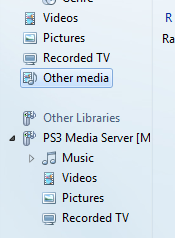
Once installed and configured the PS3 media server will become visible in media player other libraries section on all the computers on the network that have media sharing enabled.

image

Download PS3 Media server here, Installation and configuration guide can be found here.

Digital Living in 2 steps with DLNA

  1. First you need a home network — wired or wireless — and you’re ready to get started. That’s because DLNA Certified devices today connect, discover and communicate with each other over a home network, like the one you might already have for sharing your broadband Internet. (There might be other ways to connect in the future.)
  2. Next, go and buy the new DLNA Certified products available on the market today, and many more that will be available soon. Once you have those connected to your home network, and there are numerous possibilities…

The Possibilities

If you own two devices, you want them to be compatible. The same is true for three devices, or four or ten.

DLNA Certified® products are built to work together, even though they come from many different companies. Finally, you have the freedom to choose the DLNA Certified device that’s right for you, regardless of the manufacturer, and to create a digital network that fits your life.

Here are just a few examples of what’s possible with DLNA Certified products:

  • Watching home movies

    PC to network attached storage to television

    You recently downloaded your daughter’s birthday party video from your digital camcorder to your PC, and stored it on your DLNA Certified network attached storage (NAS) drive. Now you want to share it with your parents who are visiting. Step one: Use the TV’s remote to call up the video on your DLNA Certified TV. That’s it. No step two.

    Before DLNA: You probably had to burn a DVD of that video, taking hours, or you had to hook up the camcorder to the TV to watch it, fiddling with messy cables that are never where you thought you put them.

    Watching home movies

  • Listening to music

    PC to network attached storage to television

    It’s your monthly poker night and you want the guys to hear all the music you’ve copied onto your DLNA Certified PC. Your computer’s speakers are in the office, so send the songs from your PC to your DLNA Certified home stereo in the family room.

    Before DLNA: You probably had to burn CDs of your playlists, taking hours, or you had to hook up your portable music player to your stereo.

    Listening to music

  • Watching photo slideshows

    Mobile to television to network attached storage

    You can’t wait to show everyone the shot of your son’s game-winning goal captured on your mobile phone. With a DLNA Certified phone, just send the pictures to your DLNA Certified TV to relive the goal in all its triumphant detail. Then send the photo over to your DLNA Certified network attached storage (NAS) for safe keeping.

    Before DLNA: You would’ve been out of luck if you wanted to show your photo on anything other than your mobile phone’s tiny screen.

    Watching photo slideshows

  • Enjoying music
    On-the-go

    PC to mobile phone

    You want to get some music together for your family road-trip to Niagara Falls. You’re going to let your teenage son choose some of it, but you want your own tunes, too. So, from that same DLNA Certified PC on which your music is stored, you send your favorite songs to your DLNA Certified mobile phone to take with you.

    Before DLNA: Burning CDs of your road-trip playlists would just take too long, so you’d end up having to endure your son’s music.

    Enjoying music on-the-go

  • Watching TV shows

    DVR to television

    You’ve been waiting all day to watch last week’s episode of your favorite show stored on your DLNA Certified DVR. But the kids have commandeered the family room for a marathon gaming-fest. With digital living, you just get the show from the DVR, and send it to the DLNA Certified TV in your bedroom, where you can enjoy it in peace.

    Before DLNA: You might as well join the gamers since the only way to watch a recorded show was on the TV connected to the DVR.

    Watching TV shows

  • Printing photos

    Mobile to television to printer

    Your coworker just sent your phone a hilarious multimedia message photo of himself in Las Vegas. After sending the photo to your DLNA Certified TV to view it on a large screen, you know you have to share it with everyone at work. With DLNA Certified devices, just print the photo to your DLNA Certified printer, with a few simple clicks from your phone, and you can make copies for the whole office.

    Before DLNA: The only way to print photos was to get them to the PC first. And good luck figuring out how to do that from your phone.

DLNA–Explained

http://img.hexus.net/v2/internationalevents/ifa2006/dlna/dlna_logo_tn.jpg

You already know something about digital living. There’s the TV and digital video recorder in your family room. (And another set in your bedroom.) You have a PC and digital printer in your office, along with a network attached storage device. And you’ve copied all your music onto your portable music player and haven’t had to open a CD case for years
Then there are the devices that go where you go, like your mobile camera phone, digital camcorder and laptop. All from the best brands.

The compatibility challenge

But something’s missing. Why is it still so difficult to send digital content from one device to enjoy on another device?

Take video for example. It can be a real challenge to get it from your PC to the large flat-panel TV in your living room. You need to download the video from your digital camcorder to your PC, burn it onto a DVD (with complicated software) and then hand-carry it to the DVD player attached to your TV.

It can take hours. And in the end your DVD player might not even be able to read the DVD format you chose. Try it with products from different manufacturers and you might just want to skip it altogether.

DLNA Guidelines: building your network

Digital Living Network Alliance (DLNA) is helping put an end to that frustration. A collaboration of the world’s leading consumer electronics, PC and mobile companies, DLNA has created design guidelines for a new generation of DLNA Certified products that can work together — no matter the brand.

In the DLNA defined future, you’ll buy DLNA Certified products that help you share and enjoy your digital content where and when you want, at home or on the road, by yourself or among friends.