All posts by Utkarsh

Solution designer with Firstsource solutions. A post grad in Networks and IT Infrastructure. Technology enthusiast, blogger, webdesigner, Network security aspirant and in love with electronics and gadgets. This blog is an attempt to share what I find interesting... almost anything @Mtaram on twitter and

LulzSec is disbanding

http://sophosnews.files.wordpress.com/2011/06/lulzsec-wallpaper.jpg?w=640A publicity-seeking hacker group that has blazed a path of destruction on the Internet over the last two months says it is dissolving itself.

Lulz Security made its announcement Saturday through its Twitter account. In an unusual strategy for a hacker group, LulzSec has used the account as a publicity platform while remaining anonymous.

The group’s disbandment comes unexpectedly, and could be a sign of nerves in the face of law enforcement investigations. One of the group’s six members was interviewed by The Associated Press on Friday, and gave no indication that its work was ending.

LulzSec claimed hacks on major entertainment companies, FBI partner organizations, the CIA, the U.S. Senate and a pornography website.

Facebook Credits in India next month onwards

Social networking giant, Facebook has made an announcement that it would be rolling out its latest service, Facebook Credits. The bigger news here would be that the service has been launched in 11 countries, including India.

Now, in India

Starting from July 1, 2011, Facebook Credits intends to be used as an alternative payment option on the social networking giant. The payment option would be supported by Live Gamer. Facebook credits would allow users to buy virtual currency and virtual goods that are being made available to them in their Facebook apps. The only hiccup, possibly here is that the credit service doesn’t allow payment in Indian Rupees, at least for now. Therefore, users would have to purchase 50 credits for $5.

Connected to keep track of contacts and conversations

Effortless personal contact management has been the promise of countless web services for years — Etacts, Gist and Plaxo come to mind — and yet most of us still manually manage our disparate contact databases and address books, which is almost always a messy process.

Perhaps Connected can get us back on track. “The main goal of the product is to help you build, maintain and leverage your relationships,” says founder and CEO Sachin Rekhi.

The web- and mobile-friendly application hooks into nearly every social network, contact database and calendar repository on the web to automatically build out a comprehensive contact and company database, free of duplicate entries.

In Connected’s perspective, your contact database includes everyone you email via Gmail or Outlook, the people you’ve scheduled meetings with via Google Calendar, and the folks you call and text via Google Voice. It also extends to Facebook, Twitter, LinkedIn, Evernote and so forth, connecting the dots between communications — email, Twitter DMs, @mentions, Facebook messages, contacts tagged in Evernote notes et al. — across all these services to build a real-time conversation history for each contact.

Connected’s higher calling is to eliminate the manual contact entry that other services mandate and to help you better mange your professional network without the management.

“Really good sales people spend a lot of time managing and building their professional networks,” says Rekhi. “Connected is a next generation contact management solution that helps the rest of us be much more efficient.”

Even with its most basic features, Connected seems sexy; but we’ve barely scratched the surface of what the app can do. Connected will email you each morning, for instance, with a daily agenda that not only includes your appointments but any relevant social and/or news items on your contacts or their companies.

Connected comes with a rather substantial (at least for personal use) monthly financial commitment. You can access the produce free of charge for a 14 day trial period, but afterwards you’ll need to pay $9.99 per month to maintain access.

Smartphones to tell you when you are sick

Your smartphone senses your location and who you talk to when. But does can it detect when you’re feeling under the weather?

Anmol Madan explored this question in his thesis at MIT Media Lab. After completing a study that involved more than 320,000 hours of data from research participants’ mobile phones, he was able to model smartphone behaviors that predict the onset of common colds, depression, and influenza.

Now he and two other MIT alumni are using the research to launch a business. GINGER.io uses an Android app to collect SMS data, calling data and location data. When these behaviors change in a way that signals something could be wrong, it alerts the user.

Early stages of depression, for instance, often involve changes in how someone communicates. GINGER.io’s app, DailyData, picks up on those changes. In test deployments, the app was able to identify 60%-90% of the symptomatic days for mental health and common respiratory conditions. Theoretically, it will become better at doing so as more users opt to anonymously add their data to the pool for analysis.

“If you’re showing early signs of loneliness/depression, you might not report them to your doctor or family,” explains Madan. “The app currently detects these changes and sends alerts to you, but in the future, these alerts could be sent to a caretaker with your explicit permission.”

Users also have access to a dashboard that shows their baseline behavior and deviations from that baseline. It tries to predict when you might be symptomatic.

The startup used seed funding to launch with its first users in January, and it graduated from Boston TechStars earlier this month. Two medical providers are currently using the app with their patients.

Eventually, Madan hopes to pull in revenue from enterprises, providers and pharmaceutical companies that want to help their employees or patients stay healthy.

“We’re not a diagnosis,” he says. “We’re an early warning, self-support, self-serve tool.”

Laptops to be powered by Key presses

http://9.mshcdn.com/wp-content/uploads/2011/06/keyboardshot-istockphoto.jpgAustralian researchers have figured out a way to harness the energy we use while typing to power a laptop. Using piezoelectricity, this method works in a similar way to cigarette lighters that create a spark by striking a piezoelectric crystal.
To power a laptop, though, a much thinner film of the piezoelectric material would have to be developed using nanotechnology. It’s so thin, it can be coated onto various electronic parts and integrated into a variety of gadgetry.

The idea of an everlasting battery is mind boggling. Scientists are also looking into ways to power touchscreen devices with piezoelectric film, putting all that energetic finger-swiping to good use.

Could this be a way around that perennial battery power conundrum?

Internet Buttons for ease of access

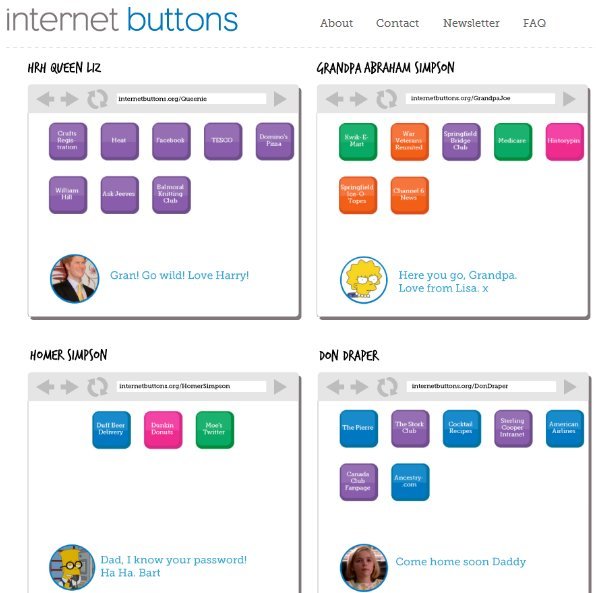
Internet Buttons is a webtool that makes the Internet super easy.

You can set up a page of personalised Buttons that click through to your favourite sites or services.

Your personalised page of Buttons is saved on its own personalised URL that you can access from any computer.

There are also loads of helper bars, tips and advice to explain how to use it and how to get more out the web.

It removes all the complicated bits of the internet and makes it easy to keep going back to the places you want to go to.

It’s the perfect thing for anyone new to the net or is just a bit web-rubbish. So if you know any one flummoxed by tweets, links and pokes or who’d appreciate learning how to email, Skype, or shop online, why not set them up with a page of Internet Buttons today?

iPad 2 has the best display

http://zapp5.staticworld.net/images/article/2011/06/tablet_image_quality_new-5188794.jpg

The first thing you notice about a tablet is its display. Even when a tablet is powered down, its display is what jumps out first, since the screen is the most dominant part. The quality of the display is a critical component of a tablet, just as image quality is essential to any screen, be it for a laptop, a monitor, a smartphone, or even an HDTV.

I’ve had dozens of tablets cross my desk, and their display quality has varied dramatically. When I look at a tablet’s display quality, I judge it on a number of criteria: brightness, color accuracy, contrast, and image clarity. The last point is a tricky one, as it covers image sharpness and detail as well as text sharpness, areas that can be influenced by how well a mobile operating system renders those elements in software.

Rewind to the debut of the first Android 3.0 Honeycomb tablets–those early models running Android 3.0 all suffered from a bug that caused digital images to render improperly in Google’s Gallery app, the default program for viewing pictures. Images looked fuzzy, with little detail. Google quietly fixed the bug later, in Android 3.1; nevertheless, image reproduction could be better, and the Gallery still natively displays images in just 16-bit color.

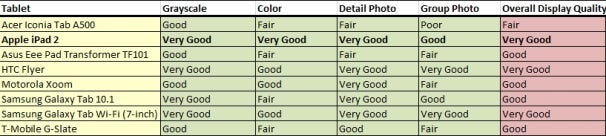
So where does that leave the discerning buyer hoping to get the best tablet display possible? To find out, the PCWorld Labs lined up eight tablets and compared their image quality side by side.

Head over to the website to see the comparison

Branchout brings career networking to Facebook

Everyone you know is on Facebook, and most people have added their resume information. But you can’t search by companies and even searching within your friends for company names is virtually impossible. So if you want to research which of your friends work at a specific company, or which friends of friends do, you head on over to LinkedIn.

Well, not anymore.

BranchOut launched this evening, a new Facebook application that makes career networking a snap. The application unlocks massive amounts of career data about my friends and friends of friends that was just impossible to get to before.

Search on a company name and see which of your Facebook friends work there (or used to). If those friends have installed the app, you can also see how many of their friends have worked at that company. You can then reach out to them for an introduction if you like.

The application also has job listings, currently free for thirty days to your direct network. Soon, says founder and CEO Rick Marini, they’ll let people put up job postings that reach all users, for $30/month. Given who’ll be using this, that should be a no brainer. We’ll certainly list TechCrunch jobs there.

Test it out and let us know what you think.

iPad 2 achieves invisibility

http://www.techhim.com/wp-content/uploads/2011/02/invisible-man.jpg

Levity Novelty LLC has today released an iPad app that provides simulated invisibility of the iPad 2 screen on a table or other environment, even as the device is moved. The Invisibility™ app is available in Apple’s online App Store for US$0.99.

The Invisibility user simply takes a photo of the table, then lays the iPad flat on the table or lifts one corner. As the user rotates the iPad around its center, or a corner, a perfectly stationary image of the table underneath remains clearly visible.

By all appearances, the screen has disappeared and the user is looking through the iPad as it moves. Users can even see the inside edge of the iPad through the screen, as well as shadows seemingly cast on the table by the empty iPad frame.

Dream of Invisibility Achieved
From the Arabian Nights to the Lord of the Rings and Harry Potter’s cloak, storytellers have dreamed of invisibility. Magicians use mirrors and sleight of hand to astonish audiences and make objects disappear. While the Invisibility iPad app can’t yet be adapted to the size and flexibility of a garment or cloak, its core method – combining cameras, motion tracking software, and a large display – can some day be combined to make a greater range of objects disappear.

Read more at the original website

Jailbreak me to introduce iPad2 Unlock

http://newstonight.net/assets/imagecache/article/ipad2.png

There is good news for iPad 2 owners who are desperately waiting to jailbreak their iPad 2, as it will be soon unveiled in Indian Market.

Apple launched its second generation iPad in March 2011, its iPad 2 jailbreak has failed to attract people but the company has announced to launch an unlock update for iPad 2 soon. According to recent reports, Comex, the famous hacker who developed the PDF-based iOS JailbreakMe 2.0, is working on an iPad 2 update. Experts have predicted that there could be a JailbreakMe 3.0.

Apple has planned to edit the iPad and iPhone’s upgrade release cycle period from one year to six months. Experts say if it happens, the current iOS jailbreakers will have less time to work on the development of various devices.

Meanwhile, Comex has tweeted that Jailbreak is almost ready for iPad 2. It has also urged the people to join the new Jailbreak on Facebook follow or twitter. Another rumor in the tech world is about Apple’s next-gen iPad 3’s release. It has been predicted that Apple will be soon lunching its iPad 3, to attract more customers.